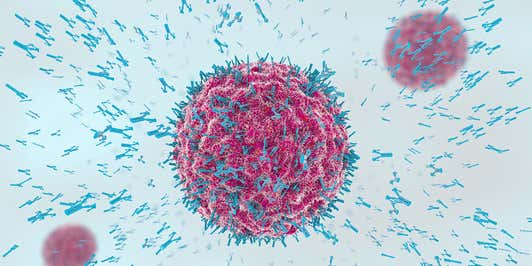
Biophysical and stability characterization of antibody-drug conjugates
Webinar

Discover how NanoSight Pro supports Quality Control and Quality Assurance by delivering reliable, reproducible data for regulatory compliant biologics and pharmaceutical development and manufacturing.

Biologics have transformed modern therapeutics, enabling highly targeted treatments across oncology, rare diseases, and advanced therapies such as gene and RNA-based medicines. These products are fundamentally different from small molecules, with complexity defined at the nanoscale. Proteins, viral vectors, lipid nanoparticles, and extracellular vesicles all exist as heterogeneous particle populations, where subtle variations can significantly impact safety and efficacy.
As biologics pipelines evolve, quality control and assurance strategies must keep pace with this complexity. Critical quality attributes such as particle size, concentration, and aggregation state are no longer secondary considerations. They are central to product performance, regulatory approval, and patient outcomes. Understanding these attributes requires analytical techniques that can resolve nanoscale behaviour with precision and confidence.
However, many traditional methods rely on ensemble measurements that mask variability within a sample. Techniques such as dynamic light scattering or chromatography provide averaged results that can overlook rare but critical subpopulations. In polydisperse systems, this lack of resolution creates blind spots that can lead to inaccurate conclusions and increased development risk.
This creates a clear analytical challenge. Scientists need tools that move beyond averages to deliver direct, particle-level insight across the biologics lifecycle. From early formulation through to final product release and stability testing, reliable characterisation at the nanoscale is essential for robust decision-making.
With NanoSight Pro you can:
✔ Measure particle size and concentration at the individual particle level
✔ Detect aggregation and heterogeneity before they impact quality
✔ Generate reproducible, decision-ready data across development and QC
 Works with OmniTrust: Malvern Panalytical's compliance solution for the regulated environment
Biologics development is inherently sensitive to nanoscale variability. Small changes in particle populations can propagate through development and only become visible when they begin to affect performance, stability, or safety. These hidden risks often originate early but remain undetected until late-stage development or even after product release.
These risks are difficult to detect because they occur within complex, heterogeneous systems where minor populations can have disproportionate impact. Conventional techniques often lack the resolution to isolate these effects, particularly when results are averaged across a distribution. At the nanoscale, critical changes can be subtle, transient, and easily masked, making them invisible without particle-resolved analysis.
Failures in biologics development often emerge during scale-up, manufacturing, or stability studies. At these stages, products are exposed to real-world conditions such as temperature variation, shear stress, and long-term storage. These factors can induce aggregation, alter particle distributions, or destabilise formulations in ways that were not evident during early development.
The root cause is often a lack of early insight into nanoscale behaviour. Small shifts in particle populations may appear insignificant in averaged data but can lead to measurable changes in efficacy, safety, or shelf life over time. As a result, issues are only identified when they become costly and difficult to resolve.
NanoSight Pro addresses this challenge using nanoparticle tracking analysis, which visualises and measures individual particles in solution. By tracking Brownian motion, it enables precise determination of particle size and concentration on a particle-by-particle basis. This allows scientists to detect early signs of instability, aggregation, or variability, supporting more informed decisions and reducing the risk of late-stage failure.
Aggregation is one of the most critical quality concerns in biologics, directly linked to immunogenicity and reduced therapeutic efficacy. Detecting subvisible aggregates, particularly in the 50 to 1000 nanometre range, requires a method that can resolve individual particles within complex formulations.
NanoSight Pro provides direct visualisation and quantification of these populations, enabling scientists to move beyond indirect or averaged measurements. By identifying aggregation early and monitoring its progression under stress conditions, it becomes possible to mitigate risk before it impacts product quality or patient safety.
With NanoSight Pro, you can:
✔ Detect and quantify subvisible aggregates in heterogeneous samples
✔ Monitor aggregation kinetics during stress and stability studies
✔ Complement existing techniques with particle-resolved insight
Formulation development and manufacturing consistency depend on precise control of particle size and concentration. In systems such as lipid nanoparticles or viral vectors, these parameters directly influence biodistribution, delivery efficiency, and therapeutic performance.
NanoSight Pro enables rapid comparison of formulation conditions, supporting optimisation of buffers, excipients, and processing parameters. By providing number-based concentration measurements, it aligns with regulatory expectations and ensures accurate dosing across batches.
With NanoSight Pro, you can:
✔ Optimise nanoparticle formulations with precise size distribution data
✔ Measure particle concentration for consistent and reliable dosing
✔ Evaluate process changes and their impact on product quality
Biologics are rarely uniform. Subpopulations such as empty and full viral capsids, labelled vesicles, or aggregated species can coexist within the same sample. Understanding this heterogeneity is essential for both development and quality assurance.
NanoSight Pro offers fluorescence capabilities that enable selective analysis of labelled particles within a complex background. This allows scientists to isolate and study specific subpopulations, providing deeper insight into product composition and behaviour.
With NanoSight Pro, you can:
✔ Analyse specific particle populations using fluorescence detection
✔ Differentiate between functional and non-functional particles
✔ Gain deeper insight into sample heterogeneity and interactions
Biologics demand a higher level of analytical precision, particularly as therapies become more complex and regulatory expectations continue to evolve. NanoSight Pro delivers this precision by combining particle-level measurement with robust, reproducible workflows suitable for both development and routine QC environments.
By enabling direct visualisation and quantification of nanoscale systems, it provides the clarity needed to make confident decisions across the product lifecycle.
From early research through to manufacturing and stability testing, NanoSight Pro supports a more proactive and informed approach to quality through:
✔ Nanoparticle tracking analysis for particle-by-particle measurement
✔ Simultaneous size distribution and concentration analysis
✔ Detection of aggregation and subvisible particles
✔ Fluorescence capability for subpopulation analysis
✔ Suitability for polydisperse and complex biologic samples
✔ Supporting stability studies and stress testing
✔ Enabling batch-to-batch consistency monitoring
✔ Reduces risk through early detection of variability
✔ Improves reproducibility with standardised workflows
✔ Accelerates development and supports regulatory compliance
NanoSight Pro transforms biologics QC and QA from an exercise in averaging to a process driven by precise, particle-level understanding. By enabling earlier insight into critical quality attributes, it reduces development risk, supports faster progression through the pipeline, and ensures greater confidence in product performance.
With better data at the right time, scientists can make informed decisions that lead to safer, more effective therapies delivered with consistency and control.



Analyse ADC heterogeneity and stability with NanoSight Pro. Detect aggregation early and optimise conjugation with particle-level insight.

Detect subtle particle differences in biosimilars with NanoSight Pro. Strengthen comparability, reduce risk, and accelerate regulatory approval.

Characterise extracellular vesicles in cell therapy. Gain nanoscale insight into cell health, potency, and consistency with NanoSight Pro.

Analyse extracellular vesicles with precision using NanoSight Pro. Detect heterogeneity, quantify particles, and de-risk exosome development. Gain reproducible insight into vesicle behaviour in solution.

Characterise viral vectors with precision using NanoSight Pro. Measure size, concentration, and aggregation to support gene therapy development.

Characterize lipid nanoparticles with precision using NanoSight Pro to optimise delivery, stability, and performance in biopharma development.

Detect protein aggregation early with NanoSight Pro. Gain particle-level insight to improve stability, reduce risk, and accelerate biologics development.

Detect mAb aggregation and particle heterogeneity early. Optimise stability and reduce risk with NanoSight Pro

Characterise nanomedicine particles with precision using NanoSight Pro. Improve stability, targeting, and development outcomes.
Measure, optimise, and control oncolytic viruses with particle-level insight to reduce risk and accelerate advanced therapy development.
Discover how NanoSight Pro supports Quality Control and Quality Assurance by delivering reliable, reproducible data for regulatory compliant biologics and pharmaceutical development and manufacturing.
Gain reproducible insight into particle and molecular behaviour in vaccine systems. Detect instability, optimise formulations and accelerate vaccine development with Zetasizer.